2026 predictions for major Wi-Fi market shifts
As we approach the final days of 2025 and anticipate the start of 2026, several shifts in Wi-Fi playbooks are expected to impact planning, design, and implementation.
- Enterprise Wi-Fi 7 becomes the “default refresh.”
Most new enterprise AP purchases are tilting toward Wi-Fi 7 (not just a niche high-density tier), with faster adoption than prior generations because there isn’t an obvious “Wave 2” detour. Wi-Fi 6E introduced 6GHz and gave some a chance to get their feet wet. With rapid adoption across client devices and optimized schedulers, Wi-Fi 7 will be the de facto choice for WLAN technology refreshes. Be sure to triple-check the data sheets for 6GHz support on Wi-Fi 7. While it is part of the standard, not all Wi-Fi 7 devices will support the 6GHz band. - Wi-Fi 7 success is judged on latency consistency more than peak speed.
Buyers will demand proof of 95th/99th percentile latency, roaming stability, and airtime efficiency, especially for voice/video, robots, and XR: pushing acceptance testing beyond throughput-only. This aligns with where Wi-Fi 8 is heading (reliability targets), and that mindset bleeds into the 2026 Wi-Fi 7 RFPs. Now that the industry has easily surpassed the throughput requirements of most applications, latency problems that may have always existed will become the metric to focus on when designing for performance and delivering exceptional user experience. - “MLO reality check” year: MLO-aware design + troubleshooting becomes mandatory.
Wi-Fi 7’s Multi-Link Operation is real—but implementations vary, and networks will need MLO-aware RF policy, band steering, and test workflows (e.g., verifying which MLO mode is supported and in use by clients). Tooling and dashboards will start surfacing link-level behaviour, not just “connected on 6 GHz.” - Standard-power 6 GHz + AFC moves from “approved” to “operational at scale” (US/Canada) and becomes a global template.
The FCC has already approved multiple AFC systems; 2026 is when more deployments operationalize standard-power 6 GHz in real networks (especially outdoor/warehouse/campus use cases), and vendors harden AFC workflows in controllers. - More regulators seriously evaluate AFC/standard-power 6 GHz, and the EU upper-6 GHz fight becomes a headline issue.
Expect more consultations and country-by-country moves on AFC and 6 GHz rules, while Europe debates whether additional 6 GHz spectrum should go to unlicensed Wi-Fi or licensed mobile/6G. The decision in Europe is not final, and there is still time to right the ship. - Very-Low-Power (VLP) 6 GHz keeps expanding the “short-range, high-capacity” story.
VLP across the full 6 GHz band enables more portable/consumer scenarios (XR, hotspots, peripherals), and you’ll see more device categories lean into 6 GHz as a “clean” spectrum layer. - Security baseline tightens: WPA3 is no longer “nice to have” in modern Wi-Fi designs.
With WPA3 required for 6 GHz operation (and commonly treated as part of “modern” Wi-Fi posture), 2026 design guides and audits will increasingly treat WPA2-only as technical debt that must be retired. WPA2-only devices should be relegated to a separate (“legacy”) SSID. Once business-critical devices no longer depend on these legacy SSIDs, they should be decommissioned. This natural evolution is not something new to Wi-Fi. We have seen a similar trend with isolating 2.4GHz-only devices to a legacy SSID, eventually decommissioning those SSIDs once the necessary client devices are 5GHz-capable. - Wi-Fi sensing moves from “demo” to early production pilots
With IEEE 802.11bf published, expect 2026 pilots in smart buildings, security, elder-care, and occupancy/energy optimization, often bundled by infrastructure vendors as a software feature on top of WLAN. There are significant opportunities for cost savings for heating, lighting, and infrastructure power. - Wi-Fi positioning/location features get a boost from new standards work
IEEE has also published 802.11bk, and you’ll see more “location as a feature” messaging tied to wide channels and improved timing/measurement, especially in enterprise campuses and in industrial environments. This will be important for wayfinding and asset-tracking solutions, as well as for reporting the GNSS position of APs/radios for Standard Power operation on 6 GHz, as required for AFC. - The toolchain shifts from “survey → deploy → hope” to continuous assurance loops.
In 2026, Wi-Fi ops will lean harder into always-on telemetry, automated anomaly detection, and closed-loop tuning (channel/power/RRM), because Wi-Fi 7-based MLO complexity makes manual-only operations brittle. - Design practices change: 6 GHz becomes the primary capacity layer; 5 GHz becomes the compatibility layer.
More WLAN designs will explicitly plan 6 GHz as the high-throughput/low-interference tier (where available), reserving 5 GHz for legacy and coverage, and 2.4 GHz mainly for IoT/edge coverage. This will be true for both regulatory domains supporting the full 1200 MHz band or the lower 500 MHz band at 6 GHz. - AFC-integrated “outdoor Wi-Fi” re-enters the enterprise conversation.
As standard-power 6 GHz becomes practical, you’ll see renewed interest in outdoor Wi-Fi for yards, campuses, ports, and logistics—often displacing some private-LTE/5G use cases where mobility + deterministic QoS aren’t strict requirements. - Carrier/ISP-managed Wi-Fi 7 ramps (including gateways + extenders), pushing better home UX expectations into enterprise.
Once customers experience more stable home mesh and better uplink behaviour, enterprise users will expect the same “it just works” roaming and app experience—raising the bar for validation metrics and SLA language. - Matter-over-Wi-Fi onboarding and “certified interoperability” becomes a bigger WLAN purchasing checkbox
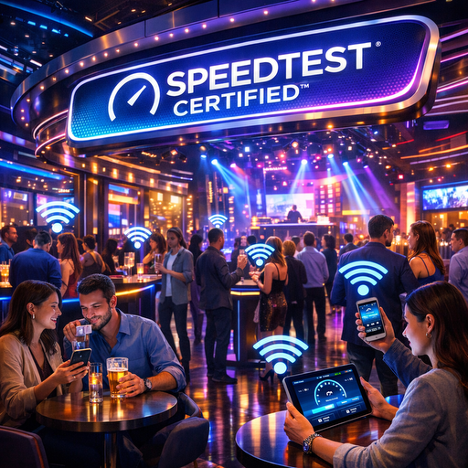
With new Wi-Fi certification tracks for Matter, AP vendors will increasingly market “smart home/building ecosystem readiness” as a differentiator. This will become a key differentiator for residential-grade Wi-Fi devices, integrating the management and configuration of multiple home wireless technologies from a common hardware platform and management console. - Speedtest Certified™. After investing strategically in advanced Wi-Fi design and infrastructure, entertainment and hospitality venues are increasingly turning to independent, data-driven performance validation to ensure a superior user experience. By certifying their networks with Speedtest Certified™, these venues demonstrate a commitment to reliability and speed—qualities that matter most to guests. As this trend gains momentum, customers are actively seeking out Speedtest Certified™ locations, choosing to spend their time and money where connectivity is proven and trusted. Venues that embrace certification not only set themselves apart but also position themselves to capture a growing segment of tech-savvy clientele.
Slàinte!