How does WirelessHART Channel Hopping Work?
This article explains how a four-slot superframe can be followed pass by pass to show how one simple formula turns a fixed schedule into a frequency-agile network.
Why WirelessHART hops at all
WirelessHART runs on the same 2.4 GHz ISM band as Wi-Fi, Bluetooth and every microwave oven in the break room. It uses the IEEE 802.15.4 radio: 15 channels numbered 11 to 25, 5 MHz apart, at 250 kbit/s and roughly 10 dBm of transmit power. That is a whisper next to a Wi-Fi access point. Note: Channel 26 is not used in WirelessHART for global compatibility reasons.
A radio on one channel loses signal whenever that channel gets busy. In a process plant, losing a reading for a few seconds can mean a control loop flying blind. So instead of fighting interference, WirelessHART simply refuses to stay anywhere long enough to be hurt by it. Every transmission lands on a different channel, chosen by arithmetic every device already agrees on.
The one formula that matters
ActualChannel = ActiveChannelTable[ (ChannelOffset + ASN) mod NumChannels ]
- ChannelOffset is the logical channel the network manager gives each link. It never changes.
- ASN (Absolute Slot Number) counts every 10 ms slot since the network was created, network-wide.
- NumChannels is the size of the active channel table: 15, minus any blacklisted channels.
The schedule stays the same, but the ASN keeps climbing, so every link lands on a new frequency each time its slot comes round.
The example network
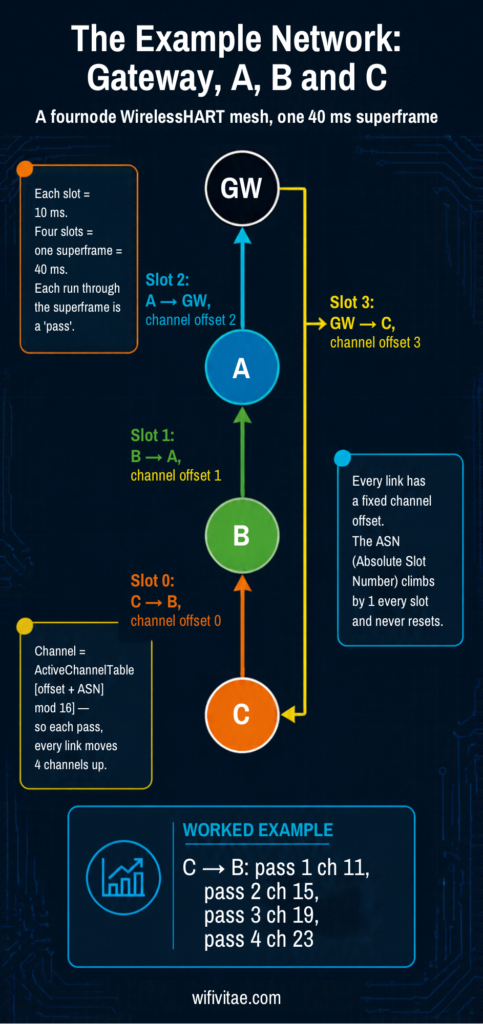
A gateway (GW), two routing devices (A and B) and a leaf transmitter (C). The network manager builds a four-slot superframe, which repeats every 40 ms.
| Slot | Transaction | Channel Offset |
|---|---|---|
| 0 | C → B | 0 |
| 1 | B → A | 1 |
| 2 | A → GW | 2 |
| 3 | GW → C (ACK/command path) | 3 |
The active channel table starts with all 15 channels, so index 0 = channel 11 and index 14 = channel 25.
How every device agrees on the time
The formula only works if every device knows the current ASN. WirelessHART is a TDMA network: time is cut into strict 10 ms slots, and the network manager hands each device a schedule saying which slot it transmits in, which it listens in, and to whom.
Keeping clocks aligned costs almost nothing extra. When a device receives a frame, it compares the arrival time with when it expected it and writes the difference into a 2-byte time-correction field in its acknowledgement. Each device follows one neighbour as its time source and nudges its clock whenever that neighbour’s ACK arrives. A device that is joining simply listens for an Advertise frame, reads the ASN from it, and lines up its first slot from the frame’s arrival time.
The result is a network where a sensor three hops from the gateway knows, to within a fraction of a millisecond, that this is slot 1,284,507, and therefore which channel to tune to.
What a “pass” means
A pass is one complete run through the superframe. Our superframe has four slots of 10 ms each, so one pass lasts 40 ms. When slot 3 ends, the superframe starts again at slot 0, and that is the next pass.
The schedule doesn’t change from pass to pass. C still talks to B in slot 0, B to A in slot 1, and so on, and every link keeps its channel offset. The one thing that changes is the ASN. It never resets, so it is 4 higher every time the superframe comes round:
| Pass | Time | ASNs Covered |
|---|---|---|
| 1 | 0–40 ms | 0–3 |
| 2 | 40–80 ms | 4-7 |
| 3 | 80–120 ms | 8-11 |
| 4 | 120–160 ms | 12-15 |
Because the ASN is part of the formula, the same link lands on a new channel each pass. Follow the C → B link (offset 0) through four passes:
- Pass 1: ASN 0, (0 + 0) mod 15 = 0, so channel 11
- Pass 2: ASN 4, (0 + 4) mod 15 = 4, so channel 15
- Pass 3: ASN 8, (0 + 8) mod 15 = 8, so channel 19
- Pass 4: ASN 12, (0 + 12) mod 15 = 12, so channel 23
So, each pass moves every link four channels up the table, wrapping back to channel 11 after 26. The schedule repeats every 40 ms, but the radio pattern doesn’t. That’s why the table below shows passes side by side: the columns are identical schedules, and only the channels differ.
Four passes through the superframe
| Pass | Slot | ASN | Offset + ASN | mod 15 | Physical channel |
|---|---|---|---|---|---|
| 1 | 0 | 0 | 0 | 0 | 11 |
| 1 | 1 | 1 | 2 | 2 | 13 |
| 1 | 2 | 2 | 4 | 4 | 15 |
| 1 | 3 | 3 | 6 | 6 | 17 |
| 2 | 0 | 4 | 4 | 4 | 15 |
| 2 | 1 | 5 | 6 | 6 | 17 |
| 2 | 2 | 6 | 8 | 8 | 19 |
| 2 | 3 | 7 | 10 | 10 | 21 |
| 3 | 0 | 8 | 8 | 8 | 19 |
| 3 | 1 | 9 | 10 | 10 | 21 |
| 3 | 2 | 10 | 12 | 12 | 23 |
| 3 | 3 | 11 | 14 | 14 | 25 |
| 4 | 0 | 12 | 12 | 12 | 23 |
| 4 | 1 | 13 | 14 | 14 | 25 |
| 4 | 2 | 14 | 16 | 0 | 11 |
| 4 | 3 | 15 | 18 | 2 | 13 |
What the table shows
- The C → B link uses channels 11, 15, 19 and 23 on successive passes. If something sits on channel 15, only one pass in four is hit, and the retry goes out on a different channel anyway.
- No two links share a channel in the same pass, because each has a different offset.
- The wrap-around in pass 4 (15 mod 15 = 0) is where the hopping cycles back through the band. Nothing has to be renegotiated.
When a transmission still fails
Hopping makes a collision unlikely, not impossible. When an ACK doesn’t come back, WirelessHART doesn’t hammer the same link again. The retry goes out in a later slot, which by definition means a different ASN and so a different channel, and usually along a different path through the mesh. The HART Communication Foundation’s redundancy paper describes up to three retries per message, each with fresh time, frequency and path.
That is three independent kinds of diversity stacked on top of each other:
- Time diversity: the retry happens in a different slot, after a short burst of interference has passed.
- Frequency diversity: the new slot maps to a new channel, away from whatever was sitting on the old one.
- Space diversity: graph routing gives each device more than one next hop, so the retry can take another route around a forklift or a steel tank.
It works in both directions, from the device up to the gateway and from the gateway back down to the device.
Adding a blacklist
Say a Wi-Fi AP on channel 1 is causing trouble on 802.15.4 channel 13, and the administrator blacklists it. The active table drops to 14 entries (11, 12, 14, 15 … 25), and the formula switches to mod 14.
| Pass | Slot | ASN | Offset + ASN | mod 14 | Physical channel |
|---|---|---|---|---|---|
| 4 | 0 | 12 | 12 | 12 | 24 |
| 4 | 1 | 13 | 14 | 14 | 11 |
| 4 | 2 | 14 | 16 | 1 | 12 |
| 4 | 3 | 15 | 18 | 3 | 15 |
Channel 13 can no longer come up. The schedule is untouched; only the table it indexes into has shrunk.
Notes for whoever designs the network
A few practical points fall straight out of the formulas:
- Know your Wi-Fi channels before you blacklist. Wi-Fi channels 1, 6 and 11 each overlap about four 802.15.4 channels. If a site has a busy access point on one of them, blacklisting the overlapping 802.15.4 channels removes them from the hop set. If not, leave the full 15in play: more channels mean more frequency diversity.
- Don’t blacklist too hard. Every channel you remove shrinks the hop set. Trim the channels that are persistently busy, not everyone that looks noisy in a single scan.
- Hopping doesn’t replace a good mesh. It handles interference; it can’t handle a missing path. The design rules still apply at least three neighbours per device, and at least a quarter of devices within direct range of the gateway.
- Update rate still drives everything. A faster update rate means more scheduled slots, more hops, and shorter battery life. Hopping keeps those slots reliable; it doesn’t make them free.
The takeaway
WirelessHART doesn’t get its interference resilience from clever retry logic bolted on top. It comes from the arithmetic: a fixed offset, a slot counter that never stops, and a table you can trim. Add retries on a different slot, channel and path, and you have the time, frequency and space diversity behind its 99%+ reliability figures.
Slàinte!